
My Experience at the 2025 Global Scaling Challenge
Key Takeaways
- A team of Plaksha University students represented the University at the 2025 Global Scaling Challenge, competing against leading universities from around the world.
- Team Phoenix successfully progressed from the Regional Qualifiers to the Global Finals by developing innovative business strategies for real-world case studies.
- The team secured a place among the top five teams globally, demonstrating strong research, collaboration and strategic thinking.
- The experience strengthened participants' skills in teamwork, stakeholder management, problem-solving and business strategy while showcasing Plaksha's interdisciplinary approach on the global stage.
The 2025 Global Scaling Challenge (GSC) organized by the Anderson School of Management at the University of New Mexico provided an extraordinary opportunity for us to engage with real-world business challenges faced by entrepreneurial firms.
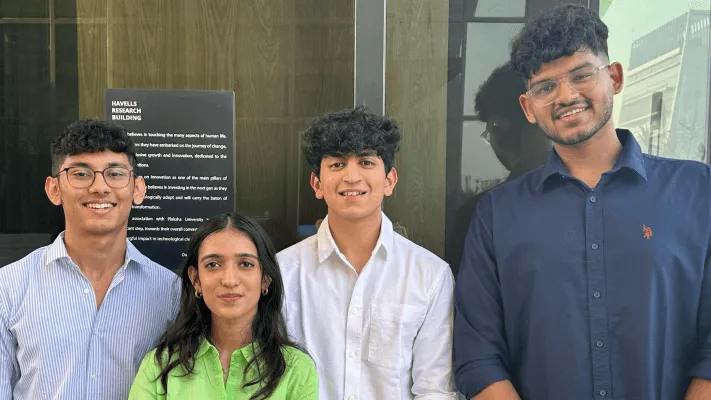
The competition, which brought together teams from universities across the world, primarily consisted of graduate students and MBA candidates, making it both highly competitive and enriching. Our team, Phoenix, was a mix of talent from Plaksha University pursuing BTech in Data Science, Economics and Business – comprising three second-year students: Advait Sharma, Aditya Shangari, and Ahaan Choksi – and me, Tanushi Khandelwal, the only third-year student.
The Global Scaling Challenge gave Plaksha students an opportunity to gain global exposure through an international competition that brought together university teams from across the world. For the team, the entrepreneurial challenge offered a valuable opportunity to apply classroom learning to real-world business problems and develop their strategic and problem-solving skills.
The competition consisted of two rounds: the Regional Qualifiers and the Global Finals, each presenting its own unique challenge. The experience began when Prof Vasudha Chopra reached out to Ahaan with this opportunity. Although our team had limited exposure to case competitions, I brought my prior experience as Vice President of Plaksha Consulting Club, which helped guide us through the entire process. Working with three juniors was both exciting and new, but we quickly formed a collaborative and highly productive team.
How Did Team Phoenix Rise to the Global Finals?
In the Regional Qualifiers, 16 teams from Asia and Oceania participated, including top MBA institutions like IIM Ahmedabad and MICA, along with two teams from Plaksha. Our task was to tackle the Nexus Health case, a healthcare provider in New Mexico. The company focuses on delivering affordable, high-quality outpatient care. We were tasked with crafting strategies to scale their operations, identify new opportunities for growth, and explore market expansion and partnership options. The process involved deep secondary research, focusing on the company’s strengths, understanding the healthcare landscape, and exploring innovative solutions to meet their goals. Although we felt relatively inexperienced, we pushed ourselves to think outside the box and challenge traditional approaches, all while receiving guidance from Prof Chopra.
Out of these 16 teams, only six advanced to the final round, and we were thrilled to be one of them. Though we were confident that our presentation had gone well, we weren’t sure if we’d win the first-round gold medal. Still, we were excited to have earned a second chance to compete at the global level, where we could apply all the lessons and feedback from the Regional Qualifiers.
The Finals presented an even more intense challenge. This time, we were working on the Hoonify Technologies case, a company that aims to democratize access to supercomputing power. Hoonify’s flagship product, Turbo OS, enables researchers, scientists and engineers to use high-performance computing with their existing hardware. Our task was to devise strategies to scale their operations, identify strategic partnerships, and explore new industries like nuclear energy and defense for future growth. This was an exciting, complex problem that required us to dive deep into technology trends, market dynamics, and potential partnerships to understand how Hoonify could expand its footprint.
In the final round, 24 teams from around the world, representing diverse continents, competed for a spot in the top 10. Every team that qualified for the finals was guaranteed a prize of $200, with special prizes ranging from $500 to $7,500 for the top 10 teams. After weeks of intense work, multiple brainstorming sessions, and a collaborative effort, we were named one of the top 5 teams globally.
Staying up until 4 AM for the results was both nerve-wracking and exhilarating, but when we found out that we had made it, all the hard work truly felt worth it.
Not only did we make ourselves proud, but we also represented Plaksha University and the DSEB cohort on the global stage, taking our institution to new heights.
Lessons Beyond the Competition
Our team’s nuanced research and innovative, detail-oriented approach were key differentiators. One of the judges even complimented our deep knowledge of the oil basins in New Mexico, a testament to how well we researched the local context, despite working from India.
This competition enhanced my skills in teamwork, stakeholder management and effective planning. The recognition and confidence I gained from this experience have been truly transformative, motivating me to keep pushing myself further, take on more challenges, and continue evolving into a better strategist – skills that will benefit me in whatever career path I pursue. The experience has also inspired me to compete more, learn continuously, and grow as a professional.
I am excited to see what my time at Plaksha brings for me in the future!
About the Author
Tanushi Khandelwal
Tanushi is a fourth-year student at Plaksha University pursuing a BTech in Data Science, Economics and Business.