
Robots Explained: From Factory Floors to Intelligent Machines
Key Takeaways
- Understanding robotics: Robotics combines engineering, computing, sensing, and AI to build machines that can perceive, process information, and act in the physical world.
- How robots work: Most robots follow a Sense → Think → Act cycle, using sensors to gather information, software to make decisions, and mechanical systems to perform actions.
- Real-world applications: Robots are already transforming manufacturing, healthcare, agriculture, logistics, and other industries by improving speed, precision, consistency, and safety.
- From robots to autonomous systems: Advances in AI, machine learning, and sensing are enabling robots to become more autonomous and adaptable, shifting the focus from replacing human tasks to enabling humans and intelligent machines to work together.
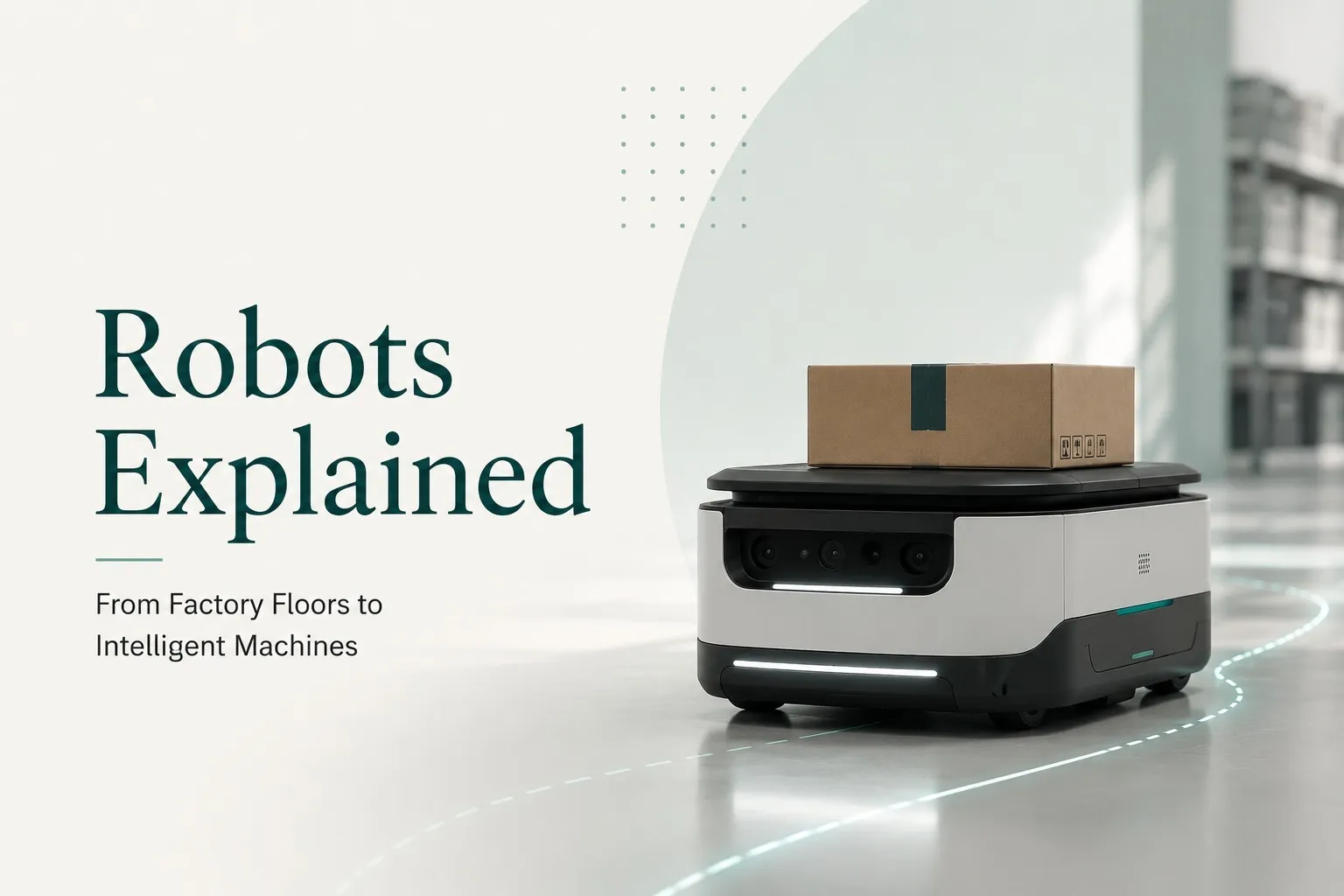
In 1972, a group of engineers pioneered the first use of AI in robotics - creating Shakey, a multi-sensor robot that could navigate its way across a room or push a box along the floor, albeit stutteringly (hence the name). But it was in 2012, when AI expert Geoffrey Hinton and his team at the University of Toronto, created a visual-recognition AI neural network based on deep learning, that it became possible for even the smallest start-ups to create and train robots that recognize everyday objects.
As industries increasingly rely on automation and intelligent systems, robots have become one of the most important technologies shaping how work gets done.
But what exactly counts as a robot? Is a self-driving car a robot? Is an automated assembly line robotic? And where do concepts like automation and autonomous systems fit into the picture?
Understanding robotics goes beyond imagining futuristic machines. Robotics combines engineering, computing, sensing technologies and increasingly artificial intelligence to create systems that can perceive the world, make decisions and perform actions in the physical environment
From industrial machines and medical assistants to autonomous delivery systems and intelligent devices, robotics sits at the intersection of the physical and digital worlds. In this guide, we'll explore what robots really are, how they work, where they are used, and why understanding robotics matters in a world increasingly shaped by intelligent machines.
What Is a Robot?
If you’ve ever asked yourself this question, you’re not alone. Even the Father of Industrial Robotics, Joseph Engelberger, is said to have remarked: “I can’t define a robot, but I know one when I see one!”
This confusion stems from the enormous variety of robots around us.
At its core, however, a robot is a programmable machine that can perform physical tasks by interacting with the world around it. Unlike software systems that exist entirely in the digital world, robots operate in real environments. And unlike fixed automatic machines such as conveyor belts, robots possess some level of autonomy — the ability to gather information, process it, and make decisions about what to do next.
A simple way to understand how robots function is through a three-step cycle:
Sense → Think → Act
First, a robot senses the world around it using cameras, sensors or other devices that collect information. It then processes that information through software and control systems to determine an appropriate response. Finally, it acts by carrying out a movement or task through wheels, motors, robotic arms or other mechanical systems.
This cycle repeats continuously, allowing robots to react and adapt to changing conditions.
Although robots can vary in size and complexity, most rely on the same set of core building blocks that make this process possible:
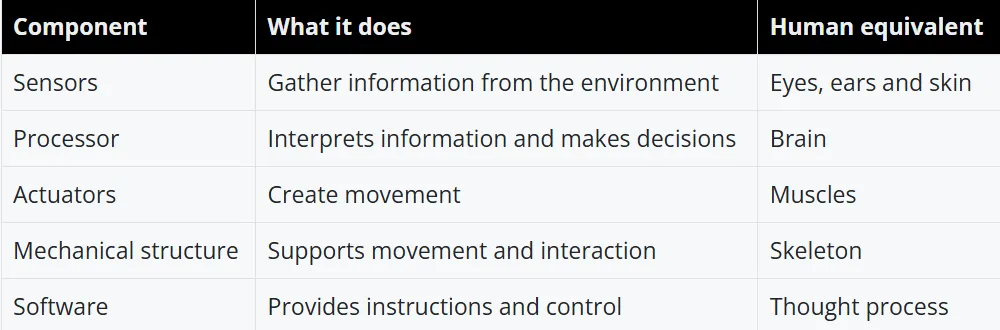
These components work together continuously. Sensors collect information, processors interpret it, software determines responses, and actuators translate those decisions into action.
Take a warehouse delivery robot as an example. Cameras and sensors help it detect shelves, packages and nearby obstacles. Software calculates the safest route to its destination, while motors move the robot through the warehouse. If a person suddenly steps into its path, the robot senses the change, recalculates its route and adjusts its movement almost instantly.
Robots in the Real World
Robots today operate across industries and environments that millions of people interact with every day. Their growing role is driven by a simple advantage: robots can perform tasks with speed, precision and consistency, especially in situations that are repetitive, physically demanding or potentially dangerous. From manufacturing plants to hospitals and farms, robotics is increasingly playing an important role in how work gets done.
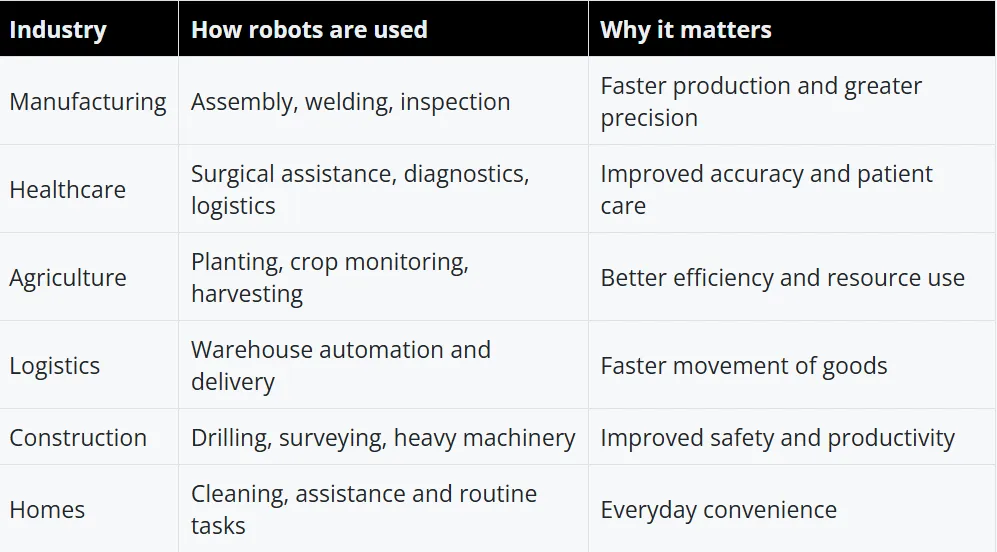
Robots are often designed around the specific challenges of each environment. In manufacturing, robotic arms perform highly repetitive tasks with consistent precision. In hospitals, surgical robots help doctors perform delicate procedures. Agricultural robots monitor crops and automate labour-intensive work, while warehouse robots continuously move inventory through complex logistics networks.
Many of these systems operate quietly in the background, which is why we may not immediately notice how common robotics has already become. Yet whether we order a package online, undergo a medical procedure, or use smart devices at home, robotics increasingly shapes experiences we interact with every day.
Rather than thinking of robots as a single category, it may help to think of them as a family of technologies. Some robots are fixed in one place, while others move. Some are remotely controlled, while others can make decisions independently. Some perform highly specialised tasks, while others are designed to adapt to changing situations. Take a robotic vacuum cleaner and a robotic surgical assistant. They may appear to have very little in common, but both use sensors, software and mechanical systems to perceive information and act in the physical world. As robotics advances, robots are also becoming more collaborative, intelligent and adaptable. Increasingly, they are being designed not just to replace tasks, but to work alongside people in everyday environments.
Why Use Robots? Advantages and Challenges
The growing use of robots across industries is not accidental. Organisations adopt robotics because machines can often perform certain tasks faster, more consistently and in environments where human work may be difficult or unsafe. At the same time, robotics also introduces challenges that extend beyond technology itself. Like most transformative technologies, robotics creates both opportunities and trade-offs.
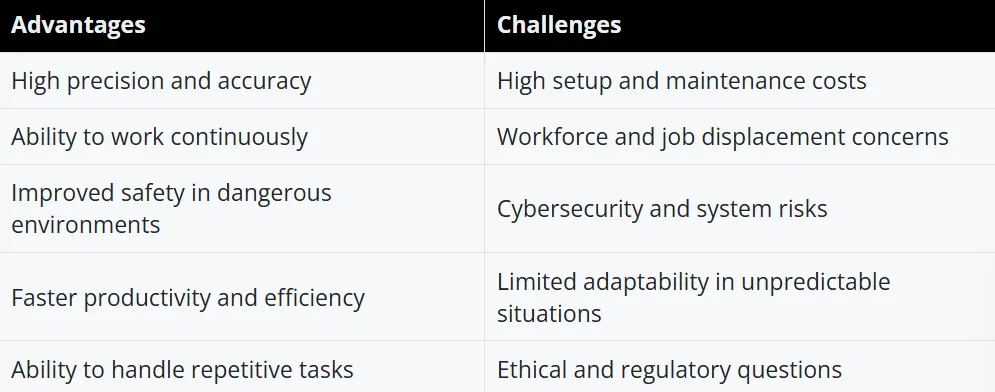
Robots are especially valuable in environments where tasks must be repeated thousands of times with consistent quality. Industrial robots can assemble products continuously, while robots used in hazardous environments reduce risks for human workers. In sectors such as healthcare and logistics, robotic systems also improve speed and operational efficiency.
However, robots are not perfect replacements for people. Many robotic systems still struggle in dynamic or unpredictable environments where human adaptability remains stronger. Questions around workforce changes, safety, ethics and trust also become increasingly important as robots move into public spaces and everyday life.
The conversation around robotics, therefore, is no longer simply Can we build robots? Increasingly, it has become How should humans and robots work together? That naturally sets up the next section: Are Robots Replacing Humans?
From Robots to Autonomous Systems
Early robots were designed to follow fixed instructions. They repeated predefined actions over and over again in controlled environments. A robotic arm on a factory floor, for example, might weld the same component thousands of times with remarkable precision—but only within the exact conditions it was programmed for. Modern robotic systems are increasingly moving beyond this model.
Advances in artificial intelligence (AI), machine learning and sensing technologies are allowing robots to become more autonomous — meaning they can make decisions and adapt their behaviour with limited human intervention. Instead of simply following a rigid set of instructions, these systems can observe their surroundings, analyse information and respond dynamically to changing situations.
A simple way to understand the difference is:
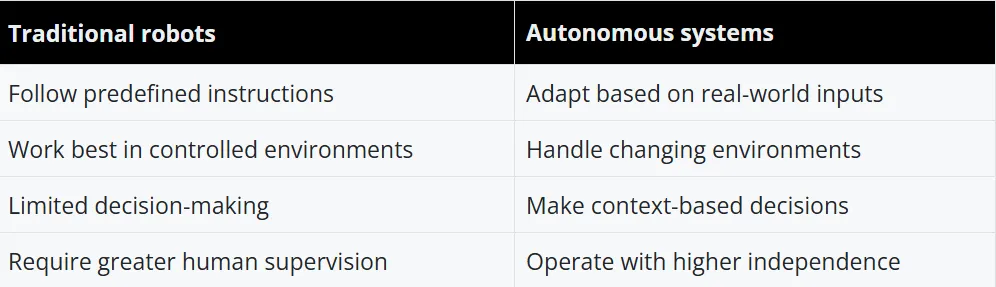
We already encounter autonomous systems more often than we realise: Self-driving vehicles navigating roads Delivery robots moving through cities Agricultural robots adjusting actions based on crop conditions Drones used for surveying, inspection and search operations Many of these systems combine robotics with AI, computer vision and real-time data analysis. Rather than acting as isolated machines, they increasingly operate as connected systems that continuously learn and improve over time. As robots become more capable of understanding and responding to the world around them, the question shifts from what robots can do today to what role they may play in the future.
Interested in building a career in robotics?
Explore our guide on the scope of robotics engineering, including courses, skills, career paths, and future opportunities in the field.
About Author
Content Team
The Content Team at Plaksha University covers the University's initiatives, academic programs, research, innovation, and the impact of its students, faculty, and collaborators, offering readers a closer look at the people and ideas shaping the future of technology education.