
Compounding Advantage: AI Strategy for Systems that Learn
About the Course Faculty
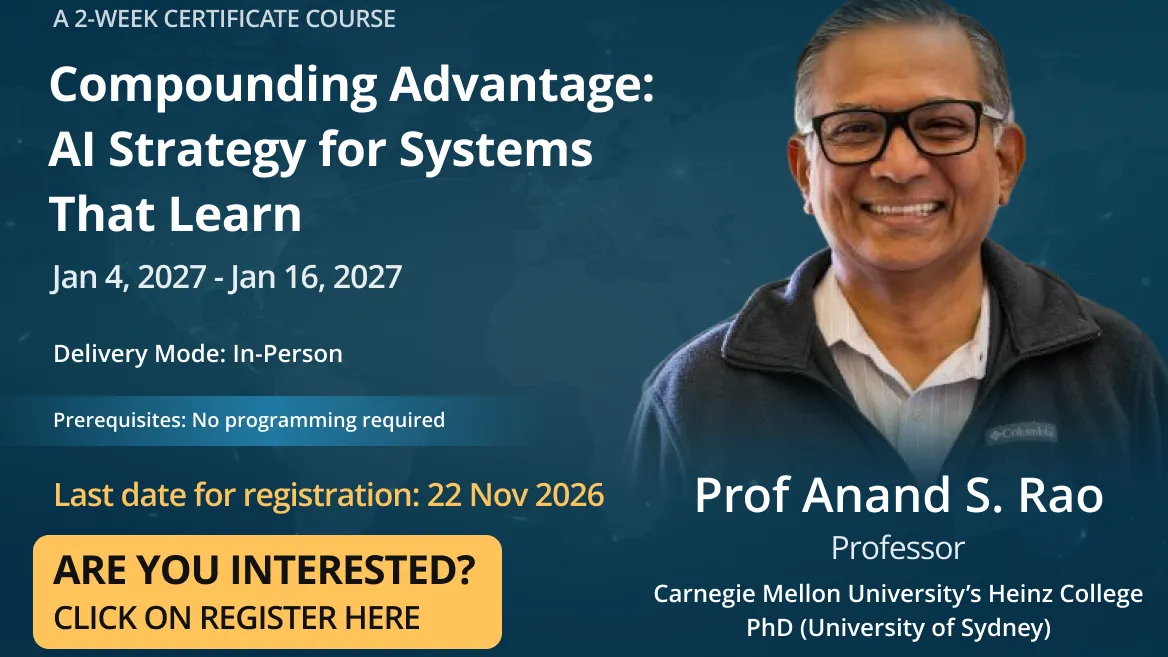
Prof Anand S. Rao | Distinguished Service Professor of Applied Data Science and AI, CMU Heinz College
- Academic Focus: Teaches Responsible AI and Operationalizing AI at Carnegie Mellon University.
- Industry Leadership: Brings 35 years of experience, including tenures as Global AI Leader at PwC and Chief Research Scientist at the Australian AI Institute.
- Global Governance: Advises the OECD, the World Economic Forum, and counsels corporate boards via CMU’s partnership with the NACD.
Plaksha Modular Courses Registration Form | Winter 2026 - 2027
As part of our upcoming Winter Modular Courses (December 14-19, 2026 & January 4-9, 2027), Plaksha is offering a set of high-impact, industry-relevant modules taught by renowned global faculty. You can sign up for these courses by filling this registration form. Please note:
1. Enrollment process: This form is to register interest in attending the courses. After submission of this form, course coordinator shall review your application and take a decision on your enrolment request. If approved, you shall receive a confirmation email along with course payment link. You can sign-up for the course by paying the course fee on the link within 3 days of receiving the form.
2. Timelines: You can submit your interest by submitting this form before Nov 22, 2026.
3. Fee: The course fee is INR 20000 inclusive of GST. Accommodation fee is separate and is applicable for those who need campus accommodation.
4. Accommodation: If you need campus accommodation, please submit your request in the accommodation question given in this form. The fee for the accommodation is INR 1000 per night. You can avail food services on campus by paying per meal at the food desk.
5. Adherence to Plaksha academic guidelines and campus life rules is mandatory while you attend this course.
6. Please read through the course timelines carefully before registering your interest.
7. Courses offer:
- AI Product Management: From User Problem to Reliable Product by Dr. Anuj Kapoor
- Frontiers in Multimodal AI by Dr. Manish Gupta
- Advanced Algorithms by Prof. Rajeev Gandhi
- Cooperation and Conflict in the Global Economy by Dr. Kamal Saggi
- Program Analysis for Modern Software Tools by Prof. Rajeev Barua
- Hands-on Deep Learning: CNN and CV Applications by Prof. Hamed Hassani
- Cybersecurity and AI by Prof Rajeev Barua
- Case Studies of AI in Business by Dr. Anand Rao
- Approximation Algorithms by Prof. Rajeev Gandhi
If you have any queries regarding this course, feel free to write us at pawan.kumar@plaksha.edu.in
When you submit this form, it will not automatically collect your details like name and email address unless you provide it yourself.
Course Description
AI capability commoditises faster than the advantage built on it forms, so the firm that creates the value is often not the firm that keeps it. Advantage lives in a loop that accumulates only while the system is operated and decays when it is neglected. Systems fail probabilistically, and agentic systems act before anyone reviews the action, which makes the boundary between human and machine authority a strategy question. The stack concentrates in a few model, cloud and compute providers, so every sourcing decision is also a dependency decision.
Durable advantage comes from cognitive capital, meaning the situated judgement an organisation accumulates through overrides, escalations, adjudications and outcomes. Any competitor can license the same model. None of them can license the judgement a firm has built by running that model against its own work for two years. The most durable returns come from boring AI, meaning advanced technology pointed at routine, high frequency work, and the showcase projects that attract budget and headlines rarely produce them. Through 2025 the large majority of enterprise AI initiatives stalled in pilot purgatory, somewhere between a convincing demonstration and a system that carries real work, and the course is an account of why that happens.
Classical strategy enters at the point of use. Rumelt’s strategy kernel, Porter’s Five Forces, transaction cost economics and the resource based view are applied to specific AI decisions and stress tested where AI economics strain their assumptions. Each team carries one assigned firm through all 10 lectures, producing five decision canvases that accumulate into a strategy addressed to the board of a listed firm or to the investors of a private one, and defended in the final session.
The course is built for students who can already build AI systems and who will shortly be asked to decide which ones deserve to exist.
Running question. You can build it, so should it be built, who captures what is created, and what makes it last after it works?
Learning Objectives
By the end of this course, students will be able to do the following.
- Diagnose the recurring decision pain in an assigned firm using the strategy kernel and jobs to be done, separating documented fact from inference, unknown and validation path.
- Assess whether the firm can capture the value an AI capability creates, given industry structure, stack position and switching costs.
- Differentiate a closed learning loop that compounds into cognitive capital from accumulated activity that does not, using production evidence of overrides, escalations and outcomes.
- Justify an architecture for the assigned firm that states what is owned, what is standardised and what is protected from standardisation, naming the dependency each choice creates.
- Specify an automation boundary for a consequential agentic action, with authority, escalation, recovery and the condition for repairing reliance after failure.
- Determine the binding institutional constraint on an unfamiliar AI deployment by comparing high compliance, operations driven, public sector and investor settings.
- Formulate an AI strategy for the board or the investors of the assigned firm in which market position, architecture, learning system, authority and capital choices reinforce one another.
Prerequisites, Assumptions and Boundaries
Prerequisites. None. No prior strategy, economics or finance coursework is expected, and each framework is introduced at the moment it is needed.
Assumptions. Working familiarity with machine learning at the level of the Master of AI core. Students are comfortable reading an evaluation report, a confusion matrix and a drift chart, since the cases carry these as exhibits inside strategy decisions. No programming is required, deliberately, because the scarce skill for this cohort is judgement about which systems deserve to exist rather than the ability to build them.
Boundaries. The following assumptions are made about related courses.
- Model architecture, training and evaluation methodology: Assumed from the program core.
- Deployment, monitoring and MLOps mechanics: Treated here as strategic constraints, not as tooling.
- Fairness metrics, assurance methods and audit mechanics: These belong to a responsible AI course. Lecture 8 treats failure, risk and harm strictly as strategic economics.
- Agent engineering and orchestration: Agentic systems appear here as a strategy problem with a distinct failure shape, and the engineering belongs elsewhere.
- Corporate finance and valuation technique: The course uses portfolio and stage gate logic and stops short of valuation.
Course Architecture
Three parts across two five-day segments, with a weekend between Lectures 5 and 6.
| Part | Lectures | The question the part answers |
|---|---|---|
|
Part Framing AI |
Lectures 1 to 3 |
The question the part answers What deserves to be built, and who gets paid when it works |
|
Part Compounding AI |
Lectures 4 to 7 |
The question the part answers What accumulates inside the firm, and what the firm must control |
|
Part Defending AI |
Lectures 8 to 10 |
The question the part answers What breaks, what binds, what gets funded, and what survives challenge |
Pedagogy
Three things run together in every lecture.
- Strategic frameworks: Introduced at the moment a live decision needs them. Each is used once at full strength and thereafter as a callback.
- Case studies: Three paired cases, each carried across two lectures, with a mid-session injection that changes the facts and forces teams to revise a position already committed to.
- Canvases: Five short decision canvases produced in the room on the team’s assigned firm, each becoming a component of the final strategy.
The canvases accumulate into the final deliverable. Canvas 1 commits to an opportunity, Canvas 2 tests where the value is captured, Canvas 3 establishes the learning system, Canvas 4 consolidates the sourcing decision from Lecture 6 with the standardisation decision from Lecture 7, and Canvas 5 names the institutional constraint. By Lecture 10 the team defence assembles work already done.
Every lecture also carries a builder’s inversion, taking a technical choice this cohort would make by instinct and showing it as a strategy decision with money, lock-in and reversibility attached.
The assigned firm and the audience for the strategy
Each team is assigned one real, publicly documented firm at the start and carries it through all 10 lectures. The set spans technology and non-technology firms, and listed and privately held ones, so the cohort works several strategic settings at once and the same framework produces different answers across teams.
The audience for the deliverable follows from the assignment. Teams with a listed firm write for its board, where disclosure, fiduciary duty and analyst scrutiny govern what counts as evidence. Teams with a private firm write for its investors, where the capital constraint is tighter, the diligence is more forensic, and the questions turn on dependency, switching costs and the credibility of the moat. Lecture 10 runs both panel types and closes on the comparison.
Teams and firms are fixed two weeks before Lecture 1, so no time in the intensive is spent on formation or selection.