
Hands-on Deep Learning: CNN and CV Applications
About the course faculty
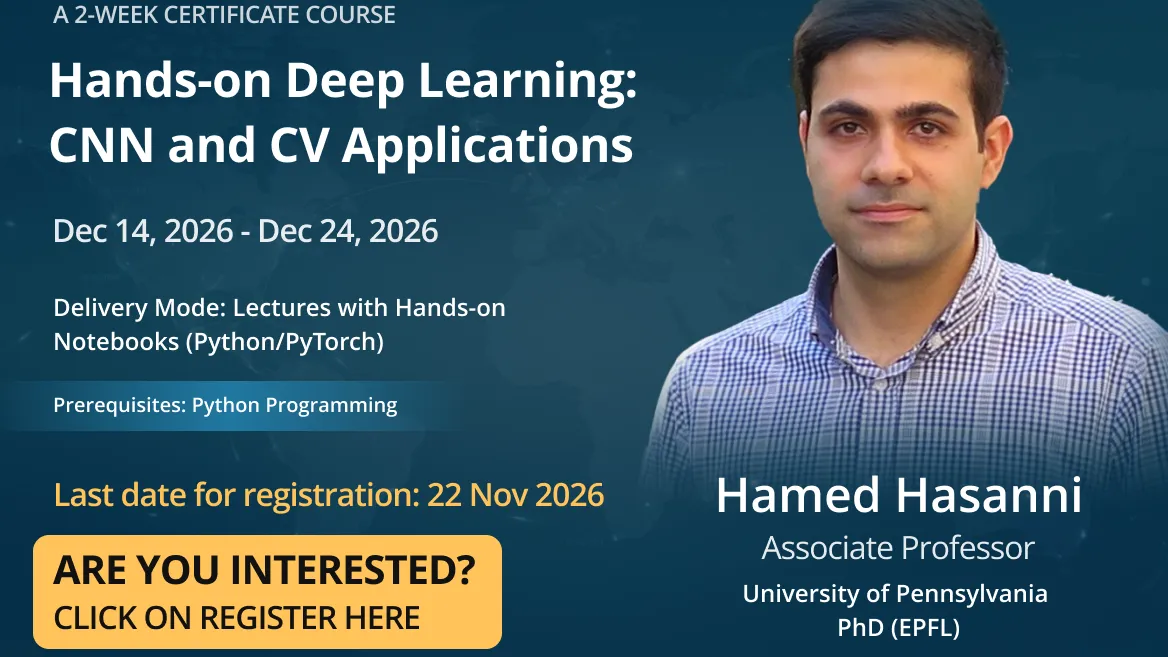
Prof Hamid Hassani is an Associate Professor at the University of Pennsylvania with appointments in Electrical & Systems Engineering, Computer & Information Science, and Statistics & Data Science (Wharton). My research spans machine learning theory, generative AI, uncertainty quantification, decision-making under uncertainty, and human–AI collaboration.
They lead research groups working across learning algorithms, large-scale generative modeling, reinforcement learning, and trustworthy AI evaluation. In addition to advising PhD students and collaborating widely across academia and industry, they contribute to open research focused on building principled, reliable foundations for modern AI systems.
Plaksha Modular Courses Registration Form | Winter 2026 - 2027
As part of our upcoming Winter Modular Courses (December 14-19, 2026 & January 4-9, 2027), Plaksha is offering a set of high-impact, industry-relevant modules taught by renowned global faculty. You can sign up for these courses by filling this registration form. Please note:
1. Enrollment process: This form is to register interest in attending the courses. After submission of this form, course coordinator shall review your application and take a decision on your enrolment request. If approved, you shall receive a confirmation email along with course payment link. You can sign-up for the course by paying the course fee on the link within 3 days of receiving the form.
2. Timelines: You can submit your interest by submitting this form before Nov 22, 2026.
3. Fee: The course fee is INR 20000 inclusive of GST. Accommodation fee is separate and is applicable for those who need campus accommodation.
4. Accommodation: If you need campus accommodation, please submit your request in the accommodation question given in this form. The fee for the accommodation is INR 1000 per night. You can avail food services on campus by paying per meal at the food desk.
5. Adherence to Plaksha academic guidelines and campus life rules is mandatory while you attend this course.
6. Please read through the course timelines carefully before registering your interest.
7. Courses offer:
- AI Product Management: From User Problem to Reliable Product by Dr. Anuj Kapoor
- Frontiers in Multimodal AI by Dr. Manish Gupta
- Advanced Algorithms by Prof. Rajeev Gandhi
- Cooperation and Conflict in the Global Economy by Dr. Kamal Saggi
- Program Analysis for Modern Software Tools by Prof. Rajeev Barua
- Hands-on Deep Learning: CNN and CV Applications by Prof. Hamed Hassani
- Cybersecurity and AI by Prof Rajeev Barua
- Case Studies of AI in Business by Dr. Anand Rao
- Approximation Algorithms by Prof. Rajeev Gandhi
If you have any queries regarding this course, feel free to write us at pawan.kumar@plaksha.edu.in
When you submit this form, it will not automatically collect your details like name and email address unless you provide it yourself.
Course Description
This 1-credit, hands-on course provides a practical dive into Convolutional Neural Networks (CNNs) and their applications in Computer Vision (CV). Designed for students with a Python programming background, the curriculum bypasses theory to focus on hands-on development using PyTorch. Students will learn to build, train, and optimize deep neural architectures for (mostly) image data. Core topics include PyTorch fundamentals, image classification, data augmentation, transfer learning, and generative models like VAEs and GANs, and (if time permits) diffusion models. By the course’s conclusion, students will be equipped to tackle real-world visual recognition tasks and deploy robust computer vision systems.
Lecture Plan
| Lecture | Topic | Topics Covered | Accompanying Materials |
|---|---|---|---|
|
Lecture Lecture 1 |
Topic Introduction to PyTorch & Autograd |
Topics Covered General course introduction, PyTorch tensors, and automatic differentiation. |
Accompanying Materials tensors.ipynb, AutoDiff.ipynb |
|
Lecture Lecture 2 |
Topic Supervised Learning & Basic NNs |
Topics Covered Linear regression with Autograd, basic neural networks, and training fundamentals. |
Accompanying Materials Linear Regression.ipynb, FullyConnectedNNs.ipynb |
|
Lecture Lecture 3 |
Topic Classification & Optimization |
Topics Covered Training on MNIST, data loading/visualization, and optimization algorithms. |
Accompanying Materials FullyConnectedNNs-2.ipynb, Optimization Algorithms.ipynb |
|
Lecture Lecture 4 |
Topic Intro to Convolutional Neural Networks |
Topics Covered The mechanics of convolutions, pooling, and building basic CNN architectures. |
Accompanying Materials CNN.ipynb |
|
Lecture Lecture 5 |
Topic Advanced CNNs & Visualizing Features |
Topics Covered Data augmentation, batch normalization, and a brief tour on deep learning generalization. |
Accompanying Materials CNN2.ipynb, Regularization.ipynb (Part 1) |
|
Lecture Lecture 6 |
Topic Transfer Learning & Fine-tuning |
Topics Covered In-distribution vs. Out-of-distribution data, fine-tuning pre-trained vision models. |
Accompanying Materials Out-of-Distribution and Finetuning.ipynb |
|
Lecture Lecture 7 |
Topic Robustness & Dimensionality Reduction |
Topics Covered Adversarial examples in computer vision, modular code writing, and Autoencoders. |
Accompanying Materials AdversarialExamples.ipynb, Autoencoders.ipynb |
|
Lecture Lecture 8 |
Topic Generative Models for CV: VAEs |
Topics Covered Formulation and training of Variational Autoencoders for image generation. |
Accompanying Materials VAEs.ipynb |
|
Lecture Lecture 9 |
Topic Generative Models for CV: GANs |
Topics Covered Architecture, training stability, and applications of Generative Adversarial Networks. |
Accompanying Materials GANs.ipynb |
|
Lecture Lecture 10 |
Topic Generative Models for CV: Diffusion Models |
Topics Covered Principles of generation with diffusion. Architecture. |
Accompanying Materials Diffusion.ipynb |
| Lecture | Topic | Topics Covered | Accompanying Materials |
This course follows the academic policies established by Plaksha University’s Office of Academic Affairs, applicable uniformly across all programs.