
Shashank Tamaskar
- Robotic autonomy
- Vision-based robot navigation
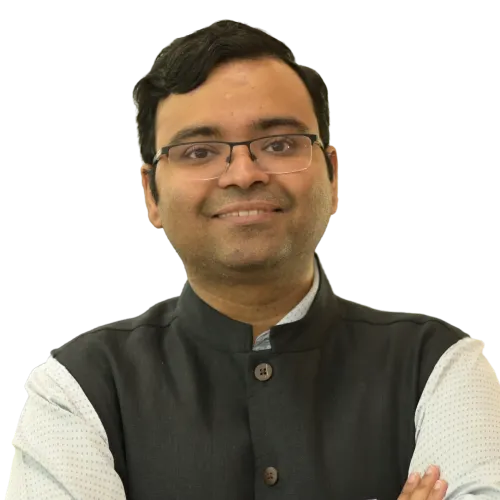
Prof Shashank Tamaskar earned his BTech from IIT Bombay in 2005 and completed his MS and PhD in Aeronautics and Astronautics from Purdue University in 2011 and 2014, respectively. After completing his PhD, he worked as a Technical Specialist in the Advanced Controls Research Group at Cummins Inc., where he developed algorithms for state estimation and applied model predictive control techniques to internal combustion engines.
At Plaksha, Prof Tamaskar pursues industry-focused research in Multi-Agent Robotic Path Planning and Control and Flexible Robotic Manipulation, with the long-term vision of advancing the adoption of robotics in India. While countries such as China and South Korea have invested heavily in robotics and automation, India still lags behind. India's robot density is only four industrial robots per 10,000 employees, compared with 732 in China and 2,589 in South Korea. Some of the key challenges associated with automation and robotics for small and medium industries include a lack of flexible technologies, high acquisition and maintenance costs, limited technical support, interoperability with legacy automation equipment, and a shortage of indigenous solutions and trained professionals. He actively seeks partnerships with like-minded individuals to help accelerate the adoption of robotics and automation in pursuit of this long-term vision.
Prior to joining Plaksha, Prof Tamaskar worked as a Research Scientist & Project Manager in Siemens Corporation, where he led a team of robotics and machine learning engineers to work on complex R&D projects related to advanced manufacturing and automation.
The research topic areas included flexible robotic control leveraging the digital twin of the manufacturing process, flexible pick and place operations and interoperability between robotic and manufacturing systems. These projects were funded by the Advanced Robotics in Manufacturing (ARM) Institute, which is a DoD sponsored public-private partnership aimed at improving the adoption of robotics in manufacturing.
Prof Tamaskar's research has led to significant improvements in engine fuel efficiency and reduction in emissions. The work is currently being deployed in production engines and has been awarded several patents. He has received multiple patents and awards for his research such as the Boeing Excellence Award for outstanding research. He also founded and led the development of the first student satellite of IIT Bombay, Pratham, which was launched by the Indian Space Research Organization in September 2016.