
Admissions Process at Plaksha — Part 1
Key Takeaways
- Plaksha holds that an applicant's most important qualities cannot be measured by marks. The university’s admissions process, therefore, considers interests, experiences and potential alongside the academic record.
- The application process runs in two stages: completing the BTech application form and a virtual interaction. This article covers the first stage.
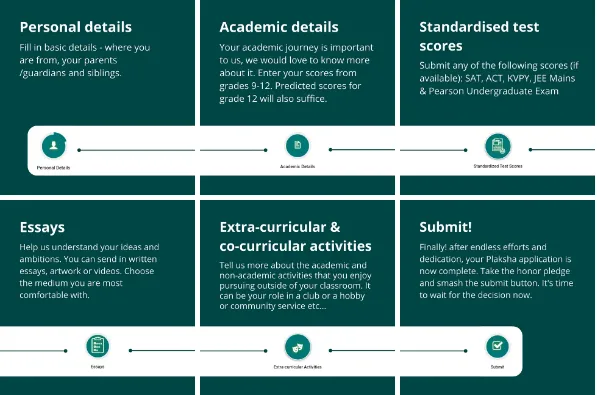
- The application form has six sections, each exploring a different aspect of the applicant's personality.
- Across those six sections, applicants reflect on what they have done, what interests them and where they want to go, rather than listing achievements.
- Applicants can attach supporting documents to the application, such as certificates, pictures, videos and artwork. These attachments show what an applicant has built outside the classroom, which grades and test scores do not capture. Plaksha recommends spending at least a week on the application so that these materials can be chosen with care.
Plaksha’s holistic admissions process explained in a two-part blog.
Plaksha follows a holistic admission process. This means that we like to know as much as possible about you. We especially, want to know what:
- Excites
- Inspires, and
- Drives you
Also, what you:
- Have done
- Want to do
We understand that intrinsic qualities cannot be measured through marks. Therefore, we believe in going beyond the marksheet.

Our admissions process has two distinct stages:
- Application Form
- Virtual Interaction
Here we will discuss the first stage.
Stage 1: Understanding the Application Form
Stage 1: Application Form
The application form at Plaksha is in six sections. Each section explores an aspect of your personality. The form is designed to make you reflect on what you have done and what you want to do going forward.
Tips for Completing a Strong Application
For students exploring Plaksha admissions and BTech admissions in India, understanding Plaksha’s holistic approach can help them prepare a stronger application. While academic credentials and standardized tests such as JEE Main, SAT and ACT form part of an applicant’s profile, the holistic admissions process looks beyond scores to understand each applicant’s interests, experiences and aspirations. Students preparing for engineering admissions in 2026 can begin by understanding the application process and carefully completing each section of the application form.
We encourage applicants to take at least a week to craft their application and add supporting documents wherever possible. You can add certificates, pictures, videos or artwork if any along with your other documents. Once you are satisfied, click ‘Submit’!
Look out for the second part of the admissions blog. Till then, go through the form and start applying.
Start your application here.
You can check out Part 2 of this series here.
You can visit this link to know more about the admissions policies.
Do you have more questions?
Every Wednesday at 5 PM, we hold virtual chatrooms to address any questions that students and parents might have. Sign up here!
About the Author
UG Team
UG Team represents the Undergraduate Admissions team at Plaksha University. The team shares insights on academic programs, the admissions process, interdisciplinary education, and student life to help prospective students make informed decisions about their undergraduate journey.
Plaksha evaluates an applicant holistically, including their interests, experiences and potential, rather than a single rank or score. The application process has two stages: completing an application form and a virtual interaction.
Each section in the application form explores a different aspect of an applicant's personality and journey, and prompts reflection on what they have done and where they want to go.
The Additional Information section takes relevant details the rest of the form does not ask for: context about an applicant's circumstances, achievements that did not fit elsewhere in the form, or anything else the admissions committee should know.
Yes. Academic performance is one part of the assessment, not all of it. The six-section form and the virtual interaction are designed to show what marks alone do not.