
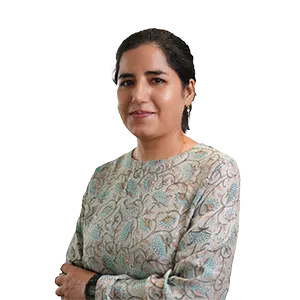
Prof Arshdeep Sidhu currently serves as an Assistant Professor and Assistant Dean, UG Outreach and Admissions at Plaksha University. She is a protein biochemist with a specialization in single molecule/conformation imaging using atomic force microscopy. Her research interest includes studying conformation-function of intrinsically disordered proteins and to develop protein-based materials for diverse applications.
She did her PhD from University of Twente, The Netherlands, where she studied polymorphism and functionalization of a Parkinson’s disease associated protein – α-Synuclein. During her postdoctoral fellowship at Erasmus Medical Centre, Rotterdam, she studied the conformation-function relation of BRCA2 protein – a protein associated with breast cancer.
In addition to her research interests, Prof Sidhu likes to travel, learn new skills and is an environmentalist, who actively seeks and implements solutions for everyday sustainable living.
We study age associated diseases like Parkinson's disease, neuromuscular diseases and cancer from molecular, clinical and ecological perspective.
At molecular and clinical level, we aim to understand how some intrinsically disordered proteins self-assemble into functional (DNA repair foci/cancer) as well as pathogenic structures (protein aggregates/Parkinson's disease). We are passionate about developing physiologically relevant in-vitro model systems, based on liquid-liquid phase separation of proteins, to study DNA repair foci and liquid to solid transition of amyloidogenic proteins. Such model systems can be valuable tools to annotate clinical variants and guide clinical decision.
At ecological level, we want to understand how some persistent and emerging contaminants in water could modify risks for neuromuscular and neurodegenerative diseases.
Prof Sidhu's current projects/themes of research include:
- PML body-based model system for homologous recombination repair of dsDNA breaks
- Automated quantitation of fluorescence microscopy images using AI-ML based methods (in collaboration with Prof Deepan Muthirayan)
- Non-invasive biomarkers for early detection of neuromuscular and neurodegenerative diseases (in collaboration with Prof Andy Ruina, Prof Deepan Muthirayan)
- Impact of emerging and persistent contaminants in water on human health (in collaboration with Prof Malini Balakrishnan and Prof Prashanth S Kumar)
- HP Chethana, U Rathan Kumar, Gunimala Chakraborty, Arshdeep Sidhu. L-arginine interferes with functional studies of amyloid proteins. Protein Expression and Purification 2026; 239, 106854.
- Aditya Iyer, Arshdeep Sidhu and Vinod Subramaniam. How important is the N-terminal acetylation of alpha-synuclein for its function and aggregation into amyloids? Frontiers in Neuroscience. 2022; 16, 16:1003997.
- M Paul, Arshdeep Sidhu, H Sánchez, SE van Rossum-Fikkert, Claire Wyman. BRCA2 diffusion and conformation linked to DNA repair function: Importance of the C-terminal domains. eLife 2021;10:e67926 * Equal contribution.
- Arshdeep Sidhu, M Grosbart, H Sánchez, B Verhagen, NLL van der Zon, D Ristić, SE van Rossum-Fikkert and Claire Wyman. Conformational flexibility and oligomerization of BRCA2 regions induced by RAD51 interaction. Nucleic Acids Research. 2020; 48 (17), 9649–9659.
- Arshdeep Sidhu, J Vaneyck, C Blum, Ine Segers-Nolten and V Subramaniam. Polymorph-specific distribution of binding sites determines thioflavin-T fluorescence intensity in α-synuclein fibrils. Amyloid. 2018; 25(3), 189-196. *Corresponding authors.
- Arshdeep Sidhu, I Segers-Nolten, V Raussens, MMAE Claessens and Vinod Subramaniam. Distinct mechanisms determine α-synuclein fibril morphology during growth and maturation. ACS Chemical Neuroscience. 2017; 8(3): 538-547.
- Arshdeep Sidhu, I Segers-Nolten and Vinod Subramaniam. Conformational compatibility is essential for heterologous aggregation of α-synuclein. ACS Chemical Neuroscience. 2016; 7(6): 719-727.
- Christian C Raiss, TS Braun, IBM Konings, H Grabmayr, GC Hassink, A Sidhu, J le Feber, AR Bausch, C Jansen, V Subramaniam and Mireille MAE Claessens. Functionally different Lewy Body-like inclusions yield insight into Parkinson's disease pathology. Scientific Reports. 2016; 6: 23116.
- Arshdeep Sidhu, I Segers-Nolten and Vinod Subramaniam. Solution conditions define morphological homogeneity of α-synuclein fibrils. BBA Proteins and Proteomics. 2014; 1844(12): 2127–34.
- Arshdeep Sidhu, A Surolia, AD Robertson and Monica Sundd. A hydrogen bond regulates slow motions in ubiquitin by modulating a β-turn flip. Journal of Molecular Biology. 2011; 411(5): 1037-48.